About
- ENABLE-6G proposes a significant upgrade of the RAN system, by exploiting the cell-free solution; specifically, ENABLE-6G’s network architecture design is based on the incorporation of the cell-free approach which significantly increases channel capacity, achieves unprecedented spectral efficiency and performance, thus able to efficiently address ultra-dense traffic requirements.
- ENABLE-6G designs a unified network infrastructure approach that simplifies the network management procedures, that resolves current synchronization packet delay issues, and ensures the use of cost-efficient commodity equipment.
- ENABLE-6G proposes SDN-enabled, ML-based slice reconfiguration algorithms, by developing novel predictive slice reconfiguration methods, leveraging Convolutional Neural Networks, by incorporating the unique features of the cell-free based network.
- ENABLE-6G proposes innovative data-driven algorithms for optimal cluster formation focusing on real-time operation, exploring fast Deep Deterministic Policy Gradients with ML models pre-trained with historic data coming from the cell-free radio architecture.
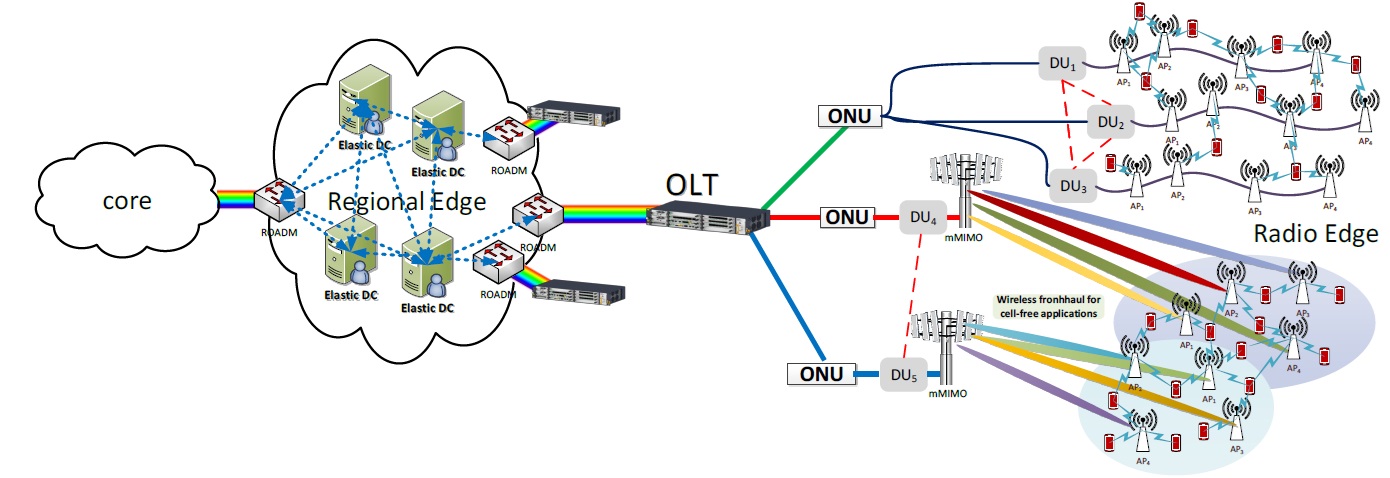
The overall architecture and the structure of the envisioned ENABLE-6G is depicted in the generic schematic of the figure above, and includes all the main infrastructure elements that are deployed within ENABLE-6G project. ENABLE-6G adopts an evolved RAN, which is extended with emerging Cell-Free technologies for network densification, which will offer unprecedented spectral efficiency and performance, which is not constrained by inter-cell interference. Moreover, ENABLE-6G considers an optical transport domain based on Passive Optical Networks (PONs), that provide fronthaul connectivity to two different Cell-Free-based radio access configurations; the first is based on the serial-fronthauling approach, while the second utilizes a mMIMO antenna to provide fronthaul connectivity to several APs. Moreover, ENABLE-6G significantly evolves the MEC system towards fully elastic Edge Computing, by deploying a distributed Edge infrastructure with Data Centres (DCs) structured in 2 tiers, featuring Regional Edge and Radio Edge nodes. Radio Edge DCs hosts the Network Functions of the (virtualized) RAN, which fully aligned with the O-RAN specifications.
Main Outcomes of the ENABLE-6G Project
- New 6G network architecture: ENABLE-6G introduced an advanced network design based on the Cell-Free concept, allowing multiple distributed access points to work together to improve coverage, capacity, and overall service quality.
- Advanced fronthaul design: The project developed a new optical-wireless fronthaul approach that supports cooperation between multiple network units, helping the network handle traffic more efficiently.
- Elastic edge computing: ENABLE-6G enhanced edge computing by introducing a flexible and distributed infrastructure that brings computing resources closer to users, reducing delays and improving the support of real-time services.
- AI-based network management: The project developed intelligent mechanisms that use Artificial Intelligence to manage network traffic, allocate resources dynamically, and adapt to changing service demands.
- Network slicing innovation: ENABLE-6G designed advanced network slicing solutions that allow the network to support multiple services with different performance requirements at the same time.
- Efficient resource orchestration: The project introduced smart orchestration methods for computing and network resources, improving efficiency and ensuring better performance for demanding applications.
- Validated performance improvements: The proposed solutions were evaluated through analytical models and simulations, demonstrating improvements in reliability, resource utilization, data rates, and latency.
The ENABLE-6G project developed innovative technologies that contribute to the future of 6G communication networks. Its main outcomes include a new Cell-Free network architecture, advanced fronthaul solutions, elastic edge computing, and intelligent network management mechanisms based on Artificial Intelligence. These innovations allow the network to become more flexible, efficient, and responsive to user needs. In addition, the project developed advanced network slicing and resource orchestration solutions that help support multiple services with different requirements, while maintaining high performance and reliability. The developed technologies were successfully evaluated through modelling and simulation, showing their potential to support next-generation applications such as smart cities, immersive experiences, connected transport, and advanced tourism services.
Dissemination
Journals
- N. Ghafouri, J. S. Vardakas, K. Ramantas and C. Verikoukis, A Multi-Level Deep RL-Based Network Slicing and Resource Management for O-RAN-Based 6G Cell-Free Networks, IEEE Transactions on Vehicular Technology, vol. 73, no. 11, pp. 17472-17484, Nov. 2024.
- N. Ghafouri, J. S. Vardakas, A. Ksentini and C. Verikoukis, High-level Service Type Analysis and MORL-based Network Slice Configuration for Cell-Free-based 6G Networks, IEEE Transactions on Vehicular Technology, 2025.
- J. S. Vardakas et al., A Self-driven Virtual Elastic Infrastructure For Cell-free Based 6G Networks, IEEE Wireless Communications, vol. 32, no. 2, pp. 188-195, April 2025.
- N. Ghafouri, J. S. Vardakas, K. Ramantas and C. Verikoukis, Towards Energy-Efficient AI: Learning Generic Assignment Skills with Unsupervised Reinforcement Learning for Network Slicing in Distributed 6G Networks, accepted in IEEE Communications Magazine, 2026.
Conferences
- I. Keramidi, J. Vardakas, I. Moscholios, M. Logothetis, and C. Verikoukis, Computational Load Offloading Mechanism in a Converged SDN Control Plane in a 6G Network, in Proc. IEEE/IET CSNDSP, 2024.
- N. Ghafouri, J. Vardakas, K. Ramantas, and C. Verikoukis, RL-Based High-Level Radio Unit Clustering and Distributed Unit Assignment in User-Centric Cell-free mMIMO for ORAN-Based 6G, in Proc. IEEE ICC 2024.
- G. Famitafreshi, M. Trigka, D. Selis, J. Vardakas, C. Verikoukis, An Innovative Multi-scale Strategy-based Decision Engine for Zero-touch Management and Orchestration in 6G", in Proc. IEEE GLOBECOM 2024.
- S. Chari, L. Garrido, J. Vardakas, K. Ramantas, C. Verikoukis, "MEC Resource Orchestration for Heterogeneous Networks and Services Using Reinforcement Learning, in Proc. IEEE GLOBECOM 2024.
- I. Keramidi, J. S. Vardakas, I. Moscholios and C. Verikoukis, "A Quantitative Comparison of Traffic Management Schemes in a Converged Optical-Wireless 6G Network, in Proc. ICTON 2025.
- N. Ghafouri, J. S. Vardakas, K. Ramantas and C. Verikoukis, Energy-Efficient Edge-Domain Automation and Service Provision in 6G Networks by Deploying Offline Discovered Assignment Skills, in Proc. IEEE ICC 2025.
- I. Keramidi, J. Lakoumentas, P. Zervou, K. Ramantas, J. Vardakas and C. Verikoukis, On the Need for Trustworthy Deep Learning Models for Efficient Resource Management in 6G Networks, in Proc. IEEE ICC 2025.
News
ENABLE-6G has participated in the IEEE/IET CSNDSP 2024 conference, where the project results have been presented!
ENABLE-6G has participated in the IEEE ICC 2024 conference, where the project results have been presented!
ENABLE-6G has published project results in the prestigious IEEE Transactions on Vehicular Technology journal!
ENABLE-6G has participated in the IEEE GLOBECOM 2024 conference, where the project results have been presented!
ENABLE-6G has participated in the IEEE ICC 2025 conference, where the project results have been presented!
ENABLE-6G has participated in the ICTON 2025 conference, where the project results have been presented!
Contact
Email us at ivardakas@uowm.gr.
Contact
| Duration | 24 months |
| Funding Agency | The research project is implemented in the framework of H.F.R.I call ‘Basic Research Financing (Horizontal support of all Sciences)’ under the National Recovery and Resilience Plan ‘Greece 2.0’, funded by the European Union – NextGenerationEU (H.F.R.I. Project Number:16294) |
| Project Coordinator | Assoc. Prof. Christos Verikoukis |
| Project Manager | Ms. Ifigenia Roumelioti |
| Partners | ISI/ATHENA, University of Western Macedonia |
